|
|
This Month
This month, we feature more farmers who are integrating and conserving wildlife habitat in their operations, researchers documenting the benefits of agricultural diversification, and conservation partners helping share these lessons across the agricultural community. From field days at a Washington dryland farm benefiting from sagebrush habitat and a California vineyard featuring Barn Owls, to a visit of extensive hedgerows at a California diversified farm, we’re seeing growing evidence that biological pest management practices can support both productive farms and healthy ecosystems.
We’re also excited to share insights from WFA Board member Catherine Badgley in her TEDx talk articulating a long-term vision for a more resilient food system, along with opportunities to learn from innovative growers and conservation leaders at an upcoming field day. Finally, we share funding and volunteer opportunities in California and Minnesota.
Thank you for being a part of the movement to create thriving agriculture landscapes that benefit farmers, wildlife and future generations.
|
|
|
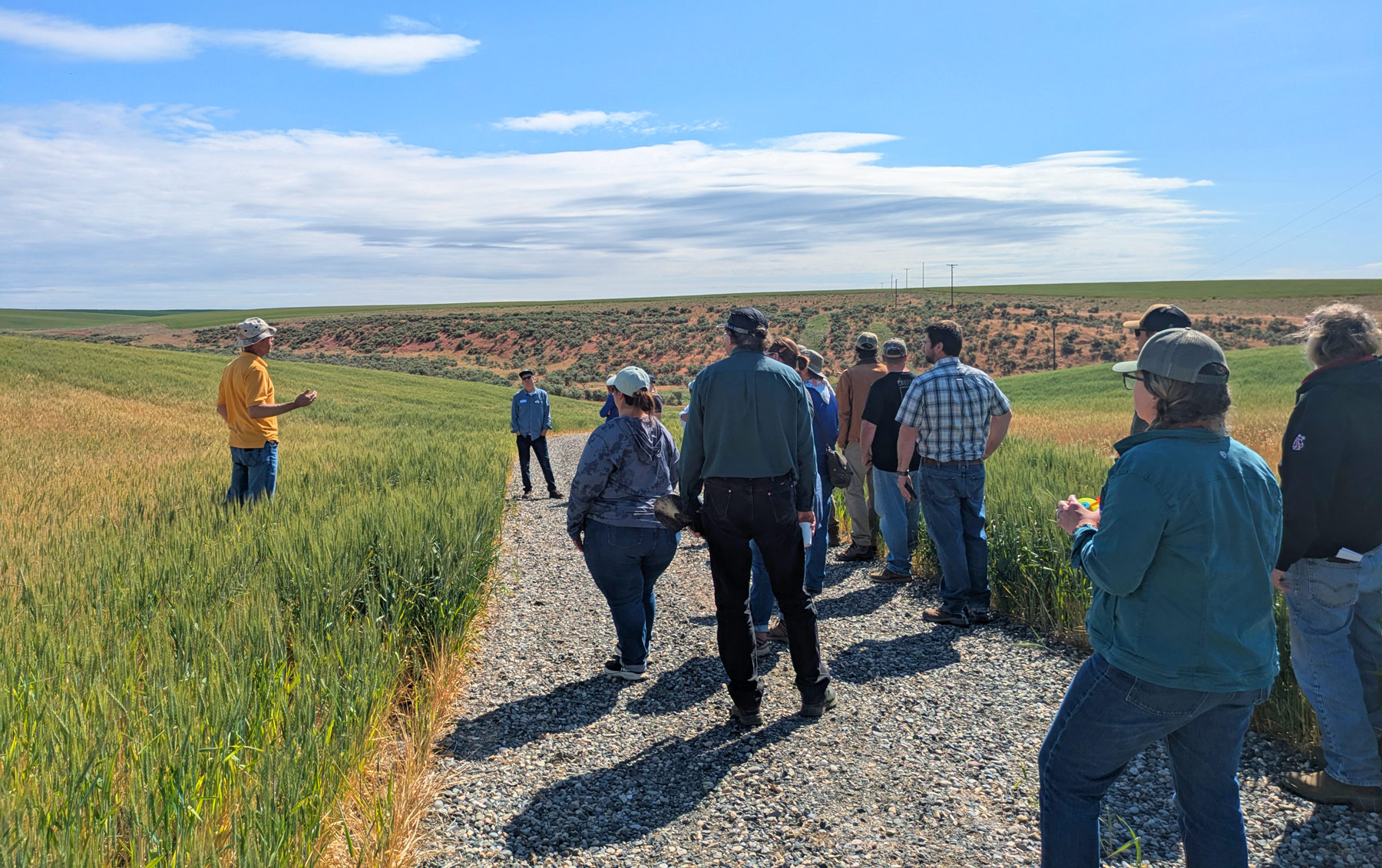
Garret Moon (left) discusses their practices on the farm, including conserving patches of native habitat (background).
Moon Family Farm Field Day Recap
On a warm and windy day in May, Wild Farm Alliance (WFA) and 24 participants gathered at Moon Family Farm in the Horse Heaven Hills of Southeast Washington for a field day co-hosted with our partners at Salmon-Safe.
Farmer Garrett Moon opened up the event by sharing the story of his family's fifth-generation, regenerative farm and the challenges of farming grains in an arid region. He highlighted the wildlife-friendly practices they’ve adopted, such as adding raptor perches, conserving native grasses and shrubs in the canyons and other sloping areas of the farm, and using precision weed control technology.
|
|

Karen Gallardo-Cruz holds the fledgling barn owl after completing the banding. Photo by Katie Goode Donaldson
Jessie’s Grove Winery Field Day Recap
WFA welcomed 50 growers, researchers, and agricultural professionals from across California to Jessie’s Grove Winery in Lodi for a dynamic field day focused on barn owls, biodiversity, and conservation strategies on working lands.
With its ancient oak trees, vibrant vineyards, and expansive network of barn owl boxes, Jessie’s Grove Winery provided the ideal setting. Vineyard Manager Jarred Shires opened the event with an overview of the 158-year-old operation, highlighting the winery’s ongoing commitment to integrating conservation practices into its land management.
|
|

Gooding Farms Field Day
July 15, 2026 | 9:00 AM – 1:00 PM | Parma, Idaho
Spend the day with fellow farmers and agricultural professionals exploring the latest tools and research on conservation practices to build soil health, strengthen pest control and improve water quality. Gooding Farms grows quality hops while enhancing biodiversity with cover crops and livestock grazing in the rows.
Sessions Include:
- Water Conservation & Drought Resilience
- Cover Crops & Soil Health
- Beneficial Birds
- Habitat Installation
|
|

Wildlife at Work: Birds, Beavers, & Beneficials at Sharing Our Roots Farm
July 21, 2026 | 8:00 AM - 1:00 PM | Northfield, MN 55057
Join fellow farmers and agricultural professionals for a FREE, hands-on field day exploring the latest tools and research on using conservation practices to support wildlife, strengthen pest control, improve water quality, and build climate resilience on Midwest farms.
Sessions Include:
- A Farm Tour
- Pollinators and Beneficial Insects
- Beavers and Water Systems
- Songbirds and Raptors
- Native Plants and Habitat
The event is free, but registration is required.
|
|

Achieving a Radiant Food System
WFA Board member Catherine Badgley recently published a journal article and gave a TEDx talk about transforming our food systems. The article analyzes the potential of organic food systems to feed the global population. It revisits her team’s 2007 study demonstrating that organic yields were sufficiently large, in principle, to provide much of the global food supply in terms of calories across all major food groups with newer research that has been done in the last 20 years.
Catherine’s TEDx talk dives into the complexity of our food system in relation to the climate crisis, including production, commercialized farming, and unsustainable methods. Through her work as a paleontologist, Catherine has learned to identify eras of extinction, and recognizes that our food system is putting us on the edge of another. The good news is that Catherine also offers actionable solutions for food system changes for both policymakers and consumers. And she highlights WFA’s Farmland Flyways trail as one of those solutions!
|
|

Terranova Ranch Conservation Hedgerows
This month, WFA Executive Director Jo Ann Baumgartner, along with farmer emeritus Tom Willey and Hedgerows Unlimited’s Sam Earnshaw traveled to Helm, California, for a hedgerow tour with Don Cameron of Terranova Ranch. Don farms 9,000 acres, of which 900 are organically managed. He has planted more than 12 miles of hedgerows, installed a 2.5 acre pond and large trees surrounding it that serve as a rookery for egrets and herons. These plantings are valuable habitat for beneficial insects, other birds and wildlife across the property.The National Center for Appropriate Technology (NCAT) visited Terranova Ranch to film these conservation efforts. In the video, Don shares how biodiversity has become an integral part of the ranch’s operation and discusses the benefits hedgerows provide for both wildlife and agricultural production.
|
|

Photo: Olivia Smith
Agricultural Diversification Maintains Productivity!
A major international study published in Science Advances found that diversified farming practices can boost biodiversity and ecosystem services without sacrificing crop yields. Researchers analyzed more than 5,000 studies and found that practices such as hedgerows, flower strips, and cover crops improved pollination, natural pest control, and soil fertility while maintaining farm productivity.
These findings reinforce what many farmers and conservation professionals have observed firsthand: working with nature can support both healthy ecosystems and successful farming operations.
|
|

Visit WFA at the Minnesota State Fair
Wild Farm Alliance is joining with Renewing the Countryside (RTC) at the Minnesota State Fair this year! Volunteer at the EcoExperience building with us and get a FREE admittance ticket to the fair for the day you volunteer and a FREE limited-edition ‘local food’ organic cotton t-shirt! Whether it’s handing out samples of dishes from our featured chefs, facilitating engaging activities celebrating MN-grown produce, or lending a hand with food prep, volunteering at the Fair is a rewarding experience that helps to connect fairgoers with vital information about supporting local food systems and a more resilient future. This year, the Food and Farming exhibit is called Bird Friendly Farming and focuses on farmers who use sustainable growing practices to support native bird populations.
Volunteer shifts are an average of three hours and are available every day of the Fair, Aug. 27th - Sept. 7th, from 9am to 7:30pm.
|
|

California Small Farm Grant Opportunity with Pine Cone Foundation
Pine Cone Foundation’s 5th Annual Grant Application is live, and $40,000 in grant funds are available! Applications are open to established small CA-based farms, ranches, fishing, and aquaculture operations looking to accomplish a specific project within one year. PCF is accepting applications from July 6 to 20, 2026. In 2026, they will distribute four $10,000 grants to eligible applicants: three to new operations and one to a PCF Grant Awardee alumnus. See link below to read their updated Eligibility and Participation Requirements to ensure you are up to speed with 2026 modifications.
|
|

Expert Birders Have Younger Brains
Research has shown that continuing to learn throughout your lifetime, and particularly as you age, can help keep the mind sharper, and protect against neurodegeneration. Farmers interested in supporting beneficial birds on their land now have another reason to dive into avian research. A new study suggests that being expert in a hobby that uses perception, attention and memory could also be effective at preserving cognitive skills.
The study, published in The Journal of Neuroscience, found that experts in bird identification had structural modifications in regions of the brain involved in attention and perception. The researchers indicate that these changes could mitigate age-related cognitive decline.
|
|
Bringing Nature Back to the Farm
|
|
|
|


