


By Alayna Merchlewitz, Program Operations Coordinator
Bright and early on July 21, Wild Farm Alliance’s Midwest staff traveled to Northfield, Minnesota, for the “Wildlife at Work: Birds, Beavers, Bats, and Beneficials on the Farm” field day, organized in partnership with Sharing Our Roots and held at their farm. The event brought together local researchers, partner organizations, and over 50 attendees to explore the many ways nature and agriculture can support one another. Over the past decade, Sharing Our Roots transformed 163 acres of previously degraded, monocropped fields into an ecologically diverse agricultural landscape, making their farm an ideal location for such an occasion.
Attendees saw the property’s transformation firsthand on a farm tour led by Sharing Our Roots Natural Lands Manager Nic Nelson. As the group explored the property’s farmland, wetlands, pastures, and prairies, Nic described the organization’s regenerative and collaborative approach to land management.

Nic Nelson and Rocky Castillas describe nest box monitoring techniques
After becoming acquainted with the land, Wildlife Technician Rocky Castillas turned everyone’s attention toward the sky. Attendees gathered in groups, binoculars in hand, to test their bird identification skills while Rocky documented the species they spotted. These observations would contribute to Wildlife Counts, a citizen science monitoring program Rocky created at Sharing Our Roots to track the farm’s growing wildlife populations.

Attendees collect bird observations for Sharing Our Roots' Wildlife Counts project
The group continued birdwatching until they reached a body of water at the edge of the property. There, University of Minnesota postdoctoral researcher Jessie Moravek pulled on her waders and introduced participants to another resident of the farm: beavers. The water where Jessie stood had previously been part of one of the most polluted bodies of water around Northfield. Her research focuses on how beavers shape aquatic ecosystems, and she explained how the wetlands created by beavers helped restore water quality that had been heavily degraded by monoculture farming.

Jessie Moravek discusses how wetlands created by beavers helped restore degraded water quality
Participants once again turned their gaze skyward as Mags Edwards, Community Science Program Coordinator with the Minnesota DNR Nongame Wildlife Program, shared how bats’ insatiable appetites for insects make them a vital ally for farmers dealing with pests.
On the walk back through the prairie, pollinator ecologist Julia Brokaw of the Xerces Society could be found along the trail with a bug net, collecting beneficial insects for her presentation. Julia used these insects to demonstrate the ecological diversity that intentional habitat design, plant selection, and management practices can support on farms.
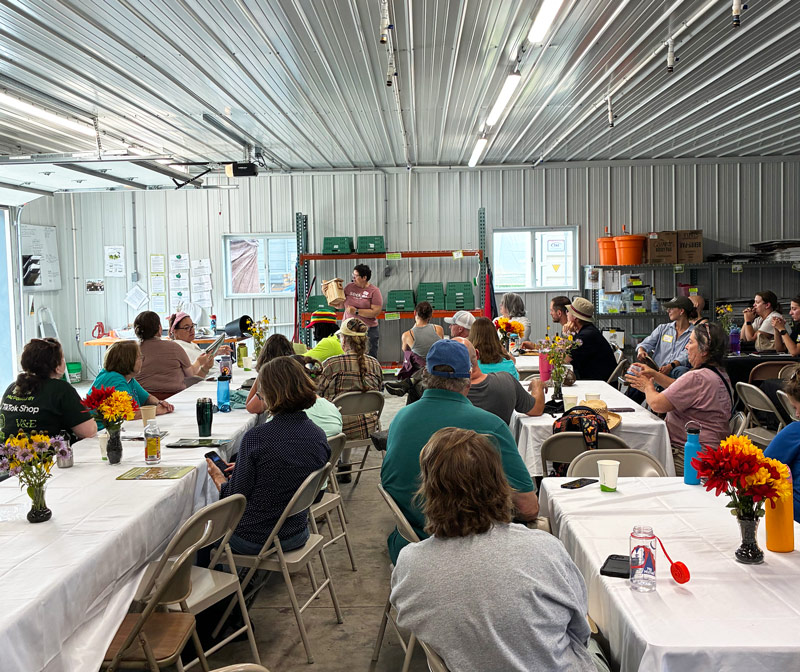
Courtney Tchida closes out the day by showcasing nest boxes for attracting beneficial birds
WFA’s Courtney Tchida closed out the day by discussing how farmers can manage pest populations and attract beneficial birds to their properties, recalling the numerous nest boxes and raptor perches the group had seen along their morning walk.
The field day at Sharing Our Roots farm offered a glimpse of what ecologically based agriculture can make possible: diverse landscapes, cleaner waterways, and skies filled with birds, bats, and beneficial insects.